
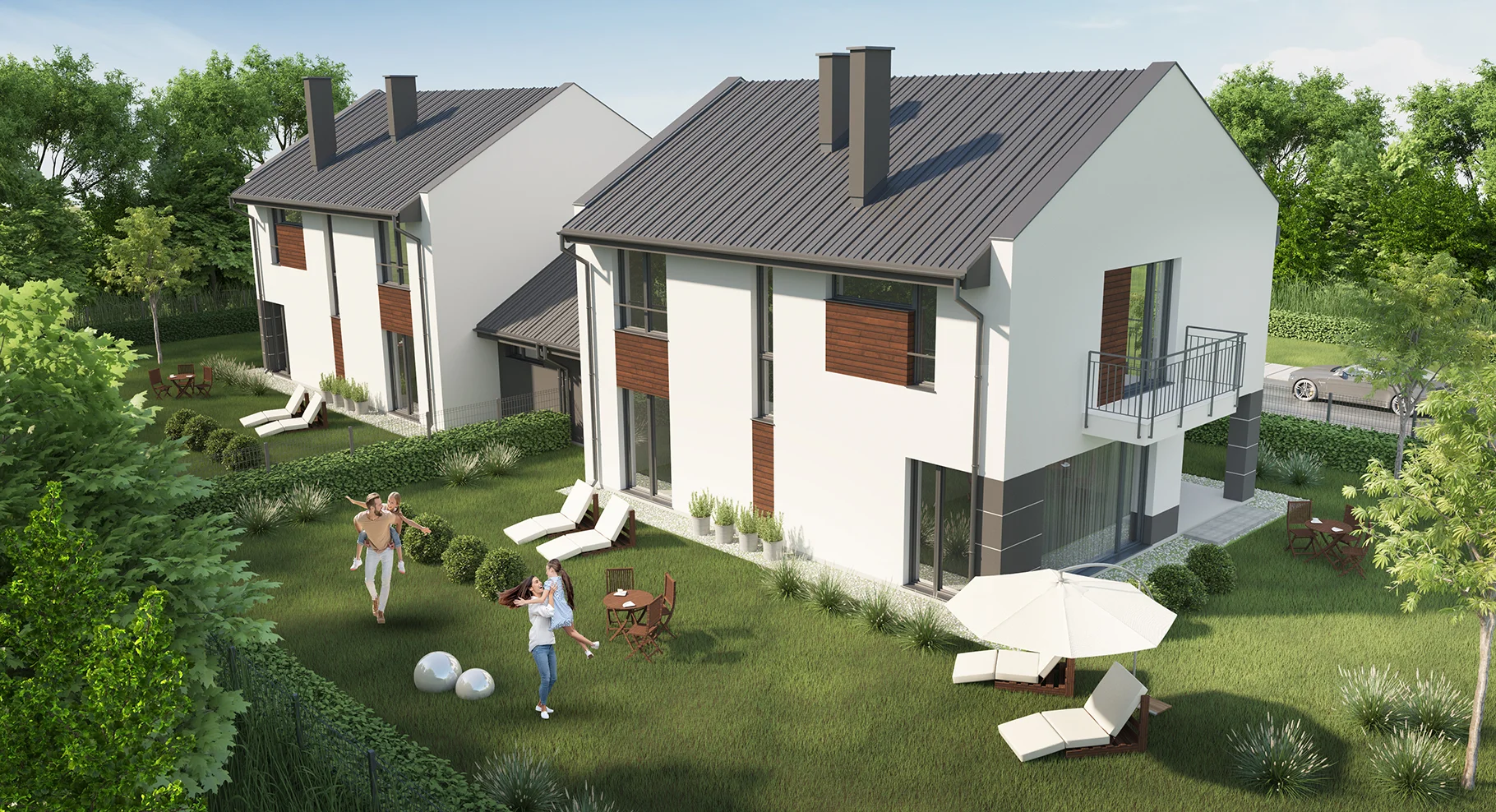
Semi-detached houses are becoming increasingly popular thanks to their optimal combination of privacy and space efficiency. One of the advantages of living in a semi-detached house is the possibility of having your own garden. Unlike apartments in blocks of flats, where access to greenery is often limited to balconies or shared areas, a semi-detached house offers a private outdoor space.
One of the key assets of our investments in Bobrowiec and Góraszka are the spacious gardens belonging to each home, which are the perfect place to rest, relax or pursue gardening passions. It is therefore worth learning how they can be arranged, especially if you are considering buying a semi-detached house from our offer.
Even a small garden allows you to create your own relaxation zone, grow plants or make a play area for children. For gardening enthusiasts it is a chance to pursue a passion, and for families – a place to spend time together outdoors. What is more, having a garden improves your quality of life by providing contact with nature without having to leave home.
So how do you plan a functional garden belonging to your home that is both attractive and practical? The key is designing the space properly.
1. Planning the space
The first step is to think carefully about what functions the garden is to serve. Should it be a place to rest, grow flowers, play with children, or perhaps combine all of these elements? Dividing the garden into themed zones allows you to make use of every square metre. For example:
– Relaxation zone: a small terrace, a garden swing or a hammock.
– Greenery zone: flower beds, ornamental shrubs or a mini vegetable garden.
– Recreation zone: space for a barbecue, a sandpit or a garden table.
2. Making use of vertical space
Smaller gardens require creative solutions. Hanging planters, walls covered with climbing plants or herb shelves are great ways to introduce greenery without taking up valuable floor space. This allows you to create a green oasis even in a limited area.
3. Choosing the right plants
The choice of plants should be adapted to the conditions of the space and its microclimate. In small gardens it is worth opting for compact species such as boxwood, lavender, azaleas or rhododendrons.
Shrubs are also an excellent solution if you want to create a natural screen in your garden. Thujas are among the most frequently chosen plants for hedges. They grow quickly, are dense and keep their green colour all year round. They are perfect for shaping and creating even, attractive boundary lines.
4. Functional surfaces
Another important aspect is the choice of surfaces. Paved paths, wooden decking boards or gravel can separate the individual zones of the garden and make it easier to move around. Using different materials gives the space character and dynamism.
5. Privacy and harmony
Maintaining privacy in a semi-detached house does not have to be difficult at all. It is enough to invest in hedges or pergolas, which also serve an aesthetic function. The thujas mentioned above, or bamboo, will also create a green wall separating us from the neighbours.
6. Lighting
A functional garden is a garden that is also usable after dark. LED lighting, solar lamps or string lights above the terrace will add charm and let you enjoy the space in the evenings.
Designing a garden in a semi-detached house does not have to be difficult. All you need is a well-thought-out plan that lets you make the most of the available space. Thanks to this, every garden becomes a place of relaxation and contact with nature – perfect for everyday rest and for meeting up with loved ones.